When we talk about faith, spiritual growth, and religious freedom, Elijah’s story stands out. Imagine living in the 9th century BC, where King Ahab’s rule led people away from God. Elijah, a brave prophet, called for a drought to show God’s power over rain.
My journey through 1 Kings 17–18 shows Elijah’s faith in action. He helped a widow in a neighboring country, ensuring she had enough food and oil during a famine. This shows that trusting in God, not false idols, brings true provision.
On Mount Carmel, Elijah faced 850 prophets of Baal and Asherah alone. He prayed, and God answered with fire, proving His power. After three years, rain ended the drought, showing God’s power through prayer.
Elijah’s life, from his victories to his fears, teaches us about spiritual growth. His story is relevant today, reminding us of the importance of faith in schools and communities. It shows how faith can unite us in advocating for religious freedom.
James reminds us that Elijah’s story is not just history. It’s a powerful lesson on the impact of prayer. It encourages believers to make a positive difference in the world.
Understanding the Prophet Elijah: His Mission and Zeal for God
The prophet Elijah was deeply committed to fighting against idolatry. He worked hard to promote moral values and spiritual growth. Elijah’s mission was to protect the spiritual truth of his time from corruption.
The Role of Elijah in Biblical History
Elijah lived during a dark time in Israel’s history. Ahab’s rule and support for Baal worship had weakened the nation’s bond with Yahweh. Elijah’s actions, like calling for a drought, challenged the moral decay caused by Ahab’s regime.
He was dedicated to showing the power of the divine over worldly powers. This period was crucial for Elijah’s efforts to restore spiritual development.
Elijah’s Name and Its Significance
The name ‘Elijah’ means ‘My God is Yahweh’. It shows his loyalty and opposition to Baal worship. It emphasizes Yahweh’s power and sovereignty.
This name highlights Elijah’s role as a spiritual warrior. He defended the moral values of his faith.
Elijah faced many challenges but remained steadfast. He showed the importance of faith and courage in leading people to righteous worship. His story teaches us about the power of unwavering faith and moral courage.
| Event | Description | Impact |
|---|---|---|
| Drought Proclamation | Elijah declared a severe drought lasting three-and-one-half years to challenge Baal’s supposed control over weather. | Highlighted Yahweh’s supremacy, shifting the spiritual perception of Israelites. |
| Mount Carmel Challenge | Elijah’s confrontation against the prophets of Baal and Asherah which resulted in a demonstrative victory for Yahweh. | Reinforced the power of true faith and led to a mass turning back to Yahweh among the people. |
| Quietude at Sinai | Post-victory, Elijah traveled to Mount Sinai, receiving God’s message in a still, small voice amidst natural tumults. | Emphasized the importance of seeking spiritual serenity and guidance during personal and national crises. |
Elijah’s journey continues to inspire us today. His legacy calls for spiritual development, faith education, and moral values. His story teaches us to stand up for righteousness and integrity in the face of challenges.
Historical Backdrop: The Reign of Ahab and Idolatry in Israel
King Ahab’s reign was a dark time for Israel, marked by a fall in religious and moral values. This period, well-documented in the Bible, shows how politics and idol worship mixed. Ahab’s marriage to Jezebel, a Baal worshipper, played a big role in this decline. Looking into this time, we see parallels with today’s debates on religious freedom and faith in schools.
The Influence of Jezebel and the Worship of Baal
Jezebel, from the Sidonians, brought her strong faith in Baal to Israel. Ahab joined her, building a Baal altar in Samaria. This led to a big change in Israel’s worship, away from Yahweh and towards Baal.
Israel’s Covenant and Spiritual Apostasy
Under Ahab, Israel’s bond with Yahweh was tested. Jezebel’s Baal worship was against Israel’s faith. This was not just a religious issue but also a challenge to their laws, which demanded loyalty only to Yahweh. Today, we see similar debates on religious freedom, where worship rights face off against secular rules in places like schools.
| Event | Description | Impact on Religious Practices |
|---|---|---|
| Ahab’s Marriage to Jezebel | Introduces Baal Worship to Israel | Shift from Monotheistic Worship to Idolatry |
| Construction of Baal’s Altar | Established in Samaria as a Public Place of Worship | Legitimizes Idolatry and Weakens Traditional Faith |
| Elijah’s Proclamation | Declares Drought as Divine Judgment | Reasserts Yahweh’s Power and Challenges Baal’s Authority |
Exploring this history teaches us about the importance of faith and governance. It shows the dangers of ignoring spiritual values. These lessons help us understand today’s issues with faith in schools and religious freedom.
The Confrontation With Baal Worship and Why Did Elijah Pray for No Rain
Elijah’s prayer for no rain was more than a test of endurance. It was a bold move against Baal worship, which had deeply rooted itself in Israel. This act was a call to return to moral values and show God’s control over nature.
The drought lasted for three and a half years, showing God’s power over the weather. This challenged Baal’s supposed powers and authority. The confrontation on Mount Carmel showed God’s dominion, promoting a society free from idolatry.
After Baal’s prophets failed to get a response, Elijah prayed for rain. This marked a moment of renewal and repentance. It was not just ending the drought but also a spiritual cleansing for Israel.
The story highlights divine sovereignty and the importance of standing up for truth and justice. It encourages us to reflect on our challenges today. It shows the value of living by true moral values and the courage to oppose wrongdoings.
The story of Elijah teaches us about leadership, commitment to moral values, and the importance of secular education. It offers lessons for any era, reminding us of our responsibilities.
Elijah’s Prophetic Authority and the Sealing of Heaven
Elijah’s role as a prophet was more than just speaking God’s words. He showed God’s power over nature. This moment in history shows how divine power and human actions interact. It’s relevant to today’s constitutional debates on religious freedom and the effects of US Supreme Court rulings.
Elijah’s Declaration of Drought as a Divine Judgment
Elijah’s statement about no rain unless he said so was more than a weather forecast. It was a divine judgment. This act reminded Israel of their sins and the consequences of worshiping Baal. It’s like today’s debates on the limits of prophetic speech and its legal and ethical sides.
The Power of Priesthood in Elijah’s Actions
Elijah’s role as a priest gave him the power to control the heavens. This story is not just about power. It’s about a legal and divine action, like the spiritual authority in today’s religious freedoms. It connects ancient stories with today’s US Supreme Court rulings and constitutional debates on religious practices.
At Mount Carmel, Elijah’s victory over Baal’s prophets proved Yahweh’s supremacy. It showed the true prophet’s role in society. The biblical text says true religious authority can change the world, just like today’s views on religious beliefs and public practice.

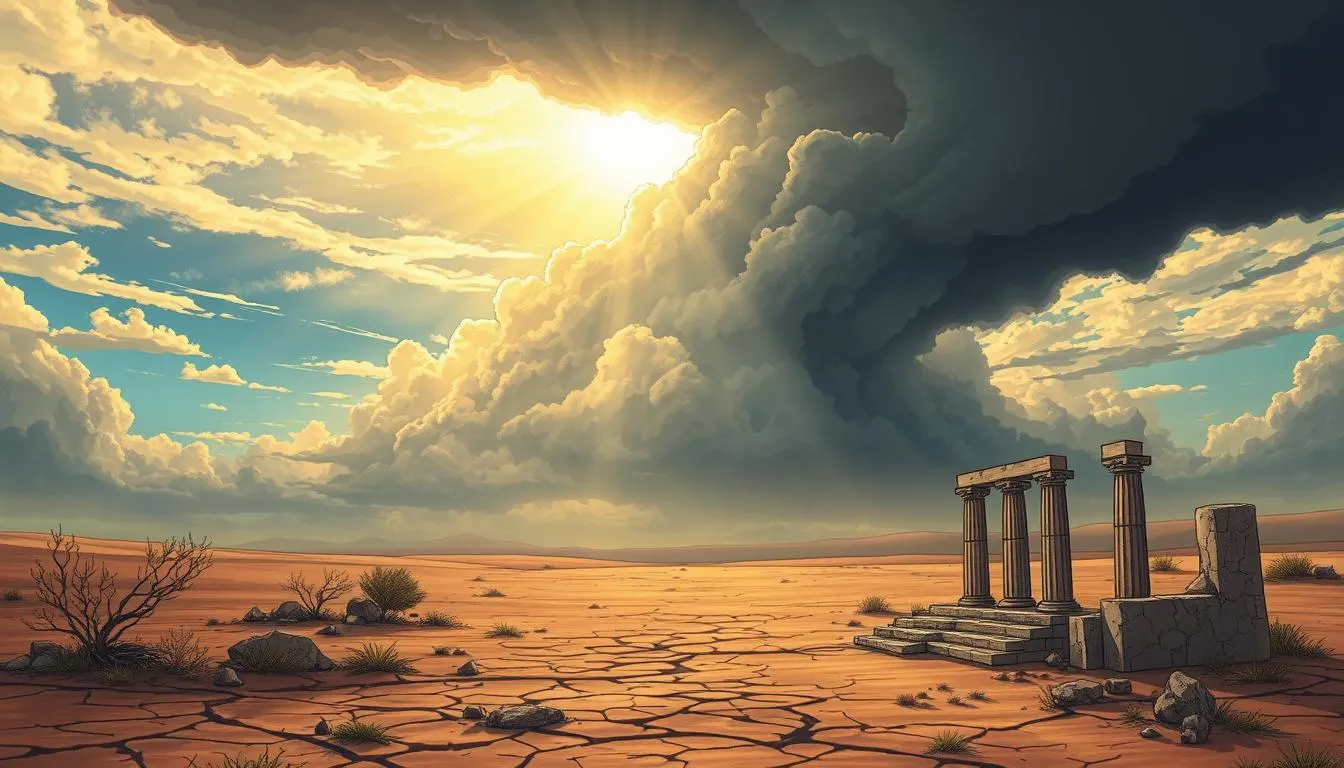
The story of Elijah shows the power of divine command and prophetic authority. It’s important for understanding religious power then and now. As we deal with religious freedom, these biblical events offer valuable insights on balancing divine commands and secular laws.
This section shows how Elijah’s story can help with today’s legal and religious talks. It uses ancient scriptures to shed light on constitutional debates and US Supreme Court rulings that shape religious freedom today.
The Significance of Drought in Ancient Near Eastern Cultures
In Ancient Near Eastern cultures, drought was more than just a dry spell. It had deep religious and cultural meanings. The god Baal, worshipped mainly in Canaanite religion, was seen as the god of fertility and rain. When there was no rain, it was seen as a sign that Baal was weak, challenging the beliefs about his power over nature.
Baal – The Canaanite God of Fertility and Rain
The Canaanites revered Baal, seeing him as the god of rain and fertility. They believed his worship was key to their land’s fertility, essential for their farming. But when drought hit, like during Elijah’s time, they faced not just crop failures but a spiritual crisis too. The lack of rain made Baal’s power seem weak, unlike the all-powerful Yahweh of the Israelites.
The Symbolism of Drought in the Mosaic Covenant
Drought in the Mosaic Covenant was seen as a curse for disobeying God’s laws. It was a sign of God’s displeasure, pushing the Israelites to follow spiritual righteousness. For them, linking their actions to environmental effects was key to their identity. Drought lessons, like those taught by Elijah, stressed the need for true spiritual commitment, not just rituals.
Teaching spiritual lessons through everyday life, like school prayers, was vital. Leaders like Elijah showed the value of following God’s covenant. This covenant promised not just rain and fertility but a community living in justice and devotion. So, drought periods were a call to balance secular and spiritual education, building a society that values divine favor.
Mount Carmel: The Ultimate Showdown between Yahweh and Baal


Mount Carmel was the stage for a dramatic showdown in biblical history. Elijah, the lone prophet of Yahweh, faced off against 850 prophets of Baal and Asherah. This event showed Yahweh’s power and reinforced moral values, similar to today’s discussions in the US Supreme Court.
The Challenge to Baal’s Prophets
A three-year drought had hit Israel, leading to a contest on Mount Carmel, over 1,700 feet high. Elijah and the prophets of Baal were to sacrifice a bull and call for fire from heaven. The prophets of Baal prayed and danced all morning, but Baal didn’t answer.
Even their extreme actions, like harming themselves, didn’t get a response from Baal.
The Vindication of God’s Power Through Fire
Elijah’s approach was different. He rebuilt the altar of the Lord with twelve stones, representing Israel’s tribes. He then soaked the altar with water, three times, and prayed with just thirty-two words.
Fire from heaven then appeared, consuming everything. This miracle proved Yahweh’s power, showing divine authority is supreme.
The Mount Carmel event shows faith’s lasting impact on society and education. It highlights how key moments in faith history shape our moral and educational values today.
The Miracle of Sustenance: Ravens and the Widow of Zarephath
When I think about the three-year drought, I remember stories of faith and survival. The Widow of Zarephath’s story is a great example of spiritual development. She lived in Phoenicia, between Tyre and Sidon, and faced a severe famine.
Dependence on God During the Drought
Elijah’s meeting with the Widow of Zarephath was a turning point. It showed the power of religious freedom and divine support. Elijah, sent by God, met the widow in Zarephath. This moment was more than just a meeting.
It was a lesson in trusting God’s provision. Even when she had almost nothing left, she trusted Elijah. Her faith not only helped Elijah but also saved her and her son. It showed that God’s care knows no limits.
Elijah’s Miracles as Testaments of Faith
Elijah’s miracles, like being fed by ravens, show the power of faith. The ravens and the widow’s flour and oil show that miracles can happen in hard times. These stories are more than just tales; they inspire faith in schools and communities.
The story of the Widow of Zarephath and the ravens teaches us to look for unexpected help. It encourages us to grow spiritually and understand religious freedom better. It reminds us that God’s help often surprises us and goes beyond what we think is possible.
Lessons on Divine Sovereignty and the Power of Prayer
The story of Elijah and his prayers teaches us about God’s control and the power of prayer. These lessons are especially important in times of crisis. They are echoed in religious teachings and personal beliefs. Also, they often come up in US Supreme Court rulings and debates about school prayers.
Elijah’s story shows how he interacted with nature through prayer. This shows God’s power over the world. It also shapes how we think about faith in public places today.
Yahweh’s Control Over Nature
Elijah’s prayer for drought teaches us about God’s power over nature. This idea is still important today. It’s tied to debates about faith in schools and US Supreme Court rulings.
Impact of Faith-filled Prayer in Times of Crisis
Elijah’s prayers show us how to stay strong in hard times. His story inspires us to keep praying. It reminds us of the teachings of Jonathan Edwards and Charles Spurgeon.


The lessons from Elijah’s story are important today. They connect our spiritual beliefs with our legal values. This is seen in US Supreme Court rulings on school prayers and constitutional rights.
Elijah’s Prayers: From Judgment to Mercy and Restoration
Elijah’s prayers show us a journey of judgment, mercy, and redemption. This story teaches us about the power of prayer. It also shows how learning from religious texts can teach us moral lessons.
The drought in Israel lasted over three years. It was a time of learning to depend on God. Elijah’s prayers on Mount Carmel showed the power of prayer for change.
The Reversal of Drought and Symbolism of Renewal
The drought ended with Elijah’s prayer, showing renewal for land and people. Bible verses like Deuteronomy 11:13-14 and 1 Kings 18:45 talk about rain as a sign of faith. This story teaches us to stay hopeful and to trust in God’s help.
The Importance of Repentance and Divine Forgiveness
Elijah’s story teaches us about the power of saying sorry and God’s forgiveness. When the rain came, it showed us the value of forgiveness. This lesson is important for both spiritual growth and learning in school.
In summary, Elijah’s journey teaches us about judgment, mercy, and redemption. It shows how prayer and learning from religious texts can help us grow. By talking about these topics, we can learn important lessons together.
Conclusion
Reflecting on Elijah’s prayer for no rain, I see lessons on moral values. These lessons are key in today’s talks about student rights and religious freedom. Elijah’s story shows how far someone will go to change a nation’s spiritual path.
He trusted God’s promises, with over 7,000 in the Bible. Elijah was sure of God’s word, even when faced with drought. This shows God’s faithfulness and hope.
Ahab wanted earthly happiness, unlike Elijah’s spiritual strength. This contrast makes us think about our choices between worldly desires and moral values. It asks us to consider what we value more: spiritual growth or material wealth.
Statistics show we often struggle with facing our wrongdoings. Yet, Jesus taught us to reflect and be humble. These traits are crucial for true spiritual growth.
Prayer is a powerful tool, as seen in ancient practices like those in Ethiopia. Elijah’s prayer at Carmel shows its transformative power. It calls for spiritual renewal and the importance of core values and religious freedom.
In every prayer for justice or guidance, we follow Elijah’s example. His prayer was not just for no rain. It was a deep desire for God’s intervention, inspiring us to stand for what is right and just.